

Use Case #1: Location Scouting
Camera Department
Traditionally, scouting a filming location means physically sending people there—director, cinematographer, production designer—often multiple times, which costs money and travel time, especially if a location is far away, hard to access, or only available for a limited window.
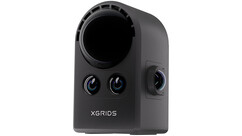
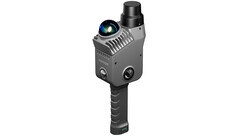
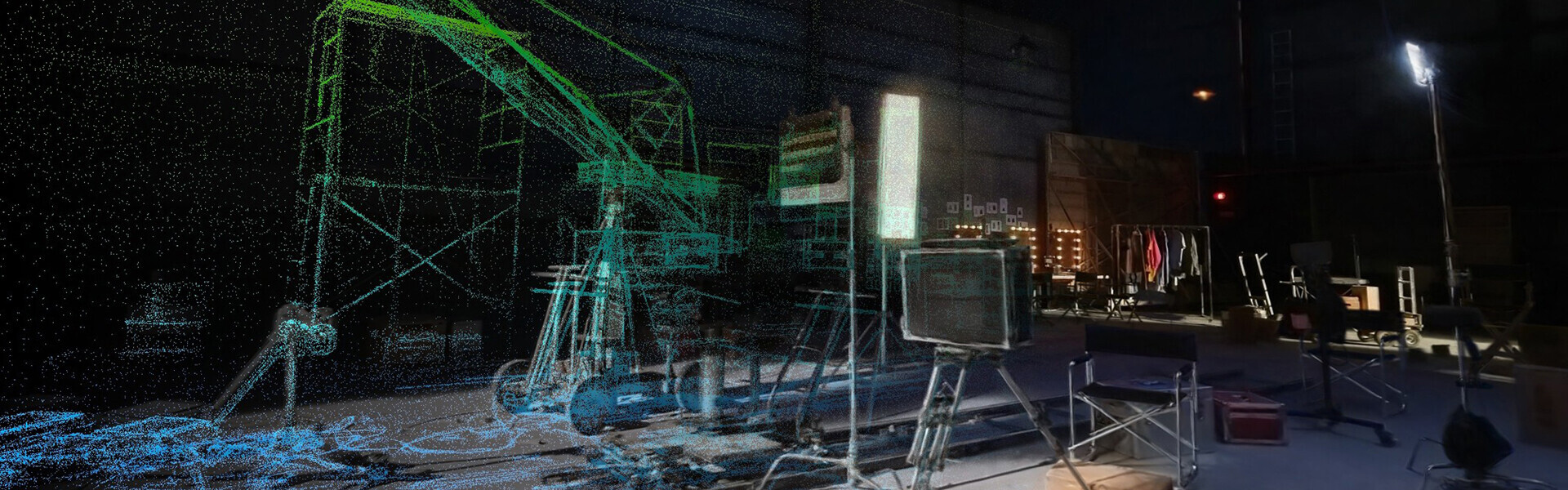
With the environmental capture process, a crew member scans the location once with a handheld device, essentially walking through the space. That scan becomes a fully-explorable 3D copy of the location that the rest of the team can access remotely.
Using a browser-based tool like Terra, decision-makers who never set foot on site can now:
- Virtually "walk" the location on a laptop
- Take precise point-to-point measurements (for example: how wide is that doorway? How tall is that ceiling?)
- Drop pins and notes directly in the 3D space for the rest of the team
- Do all of this without needing specialized 3D software skills
This turns scouting from "everyone travels to see it in person" into "one person scans it, everyone else reviews it online," which saves travel budget and lets more stakeholders weigh in earlier.
Use Case #2: Tech Vis
Lighting & Electrical Department
Before cameras roll, different departments (camera, lighting, VFX, stunts) need to plan exactly how a scene will be shot—camera angles, lighting setups, blocking, sun position—but doing that only becomes possible once you're standing on the actual set.
Because an environmental scan captures precise, centimeter-level accurate geometry (not just a rough shape), it becomes a reliable stand-in for the real place during pre-production. Teams can:
- Plan camera placement and movement virtually, ahead of the shoot day
- Simulate how sunlight will move through the space at different times of day
- Test complex or repeatable camera moves using the same tracking tech used on set
- Pre-visualize how a scene will look before committing crew and equipment time
This shifts creative and technical decisions to earlier in the process — cheaper mistakes get caught on a laptop instead of on an expensive shoot day.
Use Case #3: Digital Twin Creation
Production & Art Department
Sometimes a physical space needs to exist digitally on an ongoing basis, not just for a single shoot, but as a persistent, reusable asset. For example, a set that will be torn down but is needed again later, a venue used repeatedly for events, or a large facility being modeled for enterprise/simulation purposes.
The scan is processed into a high-fidelity, structured 3D model—complete with accurate geometry, lighting information, and photoreal textures—that can be imported into Unreal Engine and treated as a permanent, reusable copy of the real place. Because it's fully relightable, it can be:
- Reused after the physical set is gone or access is lost
- Adjusted for different weather or lighting conditions on demand
- Integrated into virtual production LED walls as a live background
- Applied outside of film entirely — for enterprise or simulation uses where an organization needs an accurate, persistent 3D model of a real facility, or for ongoing post-shoot marketing needs (such as cast interviews)
Unlike a scouting scan, a digital twin is built to last — it becomes a long-term digital asset a production or organization can keep using long after the original scan.
Use Case #4: Post / VFX
VFX Department
Visual effects work traditionally requires either building expensive physical sets, shooting on location, or relying on flat 2D photo plates and green screens that VFX artists have to painstakingly reconstruct into 3D by hand — a slow, labor-intensive process, especially for extending a set, matching a shot to an earlier scene, or replacing a background entirely.
Because the scan captures a scene as an actual 3D volumetric model (not just a flat image), it gives VFX and post teams something much more useful than a photo — a real, measurable, camera-navigable environment they can drop directly into their pipeline. This unlocks several specific workflows:
- Live compositing / background replacement — On virtual production LED-wall stages, the scanned environment can be projected live behind actors during filming, so what the camera sees in-camera is already close to final, rather than being added entirely in post.
- Matching or extending real shots — If a scene needs to continue beyond what was physically built or filmed, the 3D scan lets artists extend the environment seamlessly, because the added digital portions share the same lighting, scale, and perspective data as the real footage.
- Complex camera moves after the fact — Because the scan preserves accurate spatial data, VFX teams can create camera moves through the environment digitally—including moves that were never filmed on the actual set—using the same tracking approach as the original camera.
- Fully virtual shots — Some shots can be created entirely inside the reconstructed 3D scene, with no live-action photography at all, while still looking photoreal because the underlying data came from a real place.
- Re-lighting after the fact — Because newer techniques support relighting, VFX artists can change the time of day, weather, or lighting mood of a scene in post without needing to re-shoot.
Instead of VFX artists starting from scratch or reconstructing an environment by eye from reference photos, they inherit an already-accurate 3D version of the real location. This cuts down manual modeling work, making backgrounds, extensions, and lighting changes far more consistent with what was actually filmed.
Want to learn more about the technical specifics of the reality capture process? Read my article on the Underlying Tech & Platforms and reach out today!