



Post Production
Tutorials & Guides
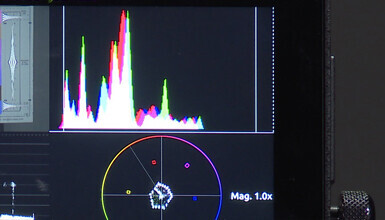
Being able to read a waveform monitor is one of the most valuable skills you can posses, both on set and in post. The waveform is the most precise way to check for exposure and, to a certain extent, color accuracy.
Tutorials & Guides
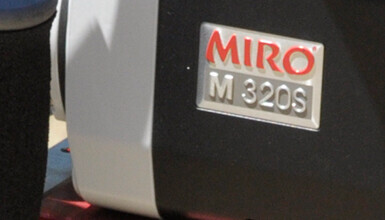
The new Phantom Miro M320S high-speed camera from Vision Research records 12-bit raw cine files for advanced color correcting with professional imaging software such as GlueTools or DaVinci Resolve. However, many shooters are instead utilizing the camera's HD-SDI output to record directly to an external device like the Sound Devices PIX 240. This is a super fast way to get gorgeous high-speed shots recorded in Apple's ProRes codec for easy ingest into an editing system.
Tech News
Pomfort has put together a new tutorial on how to use their LiveGrade software in conjunction with DaVinci Resolve to create dailies. LiveGrade can be used with hardware like the BlackMagic HD Link Pro to create LUTs live. I outlined how to apply different LUTs in a previous blog, but Pomfort has put together a very simple way to work with ASC-CDL (Color Decision List) files in DaVinci Resolve.
Tutorials & Guides
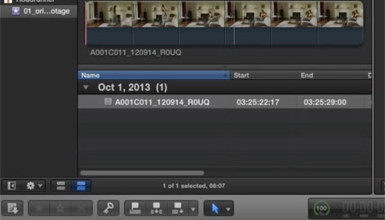
Working with Log material can be difficult at times, so we have put out a couple of different LUTs for use when using the Sony F3's S-Log or Canon Log from the Canon C300. You can download the F3 LUTs and the C300 LUTs, as many of you have already done. Arri has their online LUT Generator, and the Technicolor CineStyle LUTs are available when using the CineStyle profile on the 5D Mark II.

Tutorials & Guides
In this last part of my Sony F3 and S-log series, I go over how to generate 3D LUTs that can be used with external LUT boxes and in post. In order to do this I use an HD Link Pro from BlackMagic Design and, to control it, a program called LinkColor.

Tutorials & Guides
In this third part of my series on the Sony F65 Workflow, I go over how to use Sony's SR Compression format. In the latest firmware revision, the F65 is able to record in the SStP (Simple Studio Profile) video format, also known as the SR Compression format. This is the same format found in the F35 and other HDCAM SR recording cameras. Right now, the F65 can record in the SQ Mode (at 440 Mbps) to the SR Memory cards, with HQ and Lite options available in the future.

Tutorials & Guides
In the fourth part of my Sony F3 S-log series, I explain how to create Look Up Tables (LUTs) to be used in the camera. When shooting in S-Log, the F3 allows you to apply a LUT to an output of the camera, letting the operator visualize how the image will look after post-production correction.

Tutorials & Guides
With every new camera, comes many new questions about workflow. The term 'workflow' can be fairly broad, but today I am looking at importing C300 footage into various non-linear editing systems (NLE). The C300 uses the same workflow as the Canon XF series of cameras (which includes the XF305, XF300, XF105 and XF100), because it records in the same format. However, the tools for importing the footage have been updated by Canon. Below, I outline how to ingest footage onto a hard drive, and how to import into Avid Media Composer, Final Cut Pro 7, Premiere 5.5 and Final Cut Pro X. Keep reading for a brief how-to on each process.

Tutorials & Guides
When Arri released the SUP 4.0 firmware for the ALEXA, they also added the ability to create color 'Looks' to load into the camera. These Look files are similar to scene files found in other cameras, but they aren't burned into the Log C recording of the camera. Instead, they can be used in post by converting them to LUTs using Arri's LUT Generator. These looks then travel as metadata with the clips recorded (through the XML file). Look files can be created by saving a still from the camera and loading it into the Arri Look Creator, which can then modify the still and output a look.